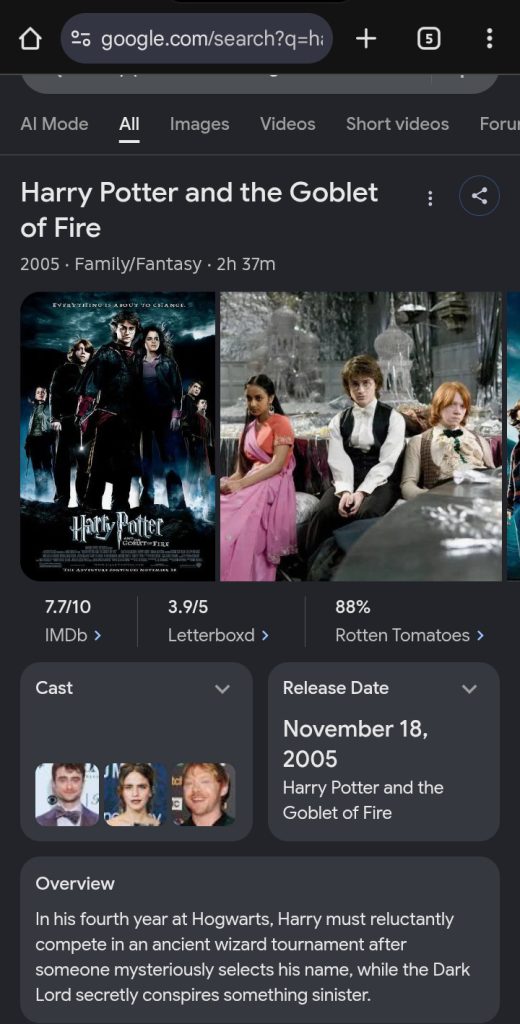

Harry Potter and the Goblet of Fire is the fourth installment in J.K. Rowling’s Harry Potter series and one of the most important turning points in Harry’s journey.
The story follows Harry Potter during his fourth year at Hogwarts School of Witchcraft and Wizardry, where he unexpectedly becomes a competitor in the dangerous Triwizard Tournament. Although Harry is too young to enter and insists that he never submitted his name, the magical Goblet of Fire selects him as an additional champion.
But there is a much bigger problem.
Harry’s participation in the tournament is not an accident.
Behind the dragons, underwater challenges, magical celebrations, teenage rivalries, and international competition, a carefully planned conspiracy is unfolding.
Its ultimate objective is terrifying: deliver Harry Potter directly to Lord Voldemort.
By the end of Harry Potter and the Goblet of Fire, the series undergoes a major transformation. Voldemort returns to physical form, Cedric Diggory is murdered, Harry discovers that someone inside Hogwarts has been manipulating the tournament, and the wizarding world faces the possibility of another war.
Here is a detailed look at the plot, major characters, Triwizard Tournament, themes, ending, and significance of Harry Potter and the Goblet of Fire.
What Is Harry Potter and the Goblet of Fire About?
Harry Potter and the Goblet of Fire follows Harry Potter as he becomes an unexpected fourth competitor in the Triwizard Tournament, a prestigious magical competition traditionally involving three wizarding schools.
The participating schools are Hogwarts School of Witchcraft and Wizardry, Beauxbatons Academy of Magic, and Durmstrang Institute.
Each school is supposed to have one champion.
However, after Cedric Diggory, Fleur Delacour, and Viktor Krum are selected to represent their respective schools, the Goblet of Fire unexpectedly produces another name:
Harry Potter.
Harry is only fourteen and therefore should not have been eligible to enter.
Even more importantly, Harry insists that he never submitted his name.
Nevertheless, he is required to compete.
What initially appears to be a mysterious problem surrounding a magical school competition gradually develops into something far more sinister. Harry eventually discovers that his participation has been engineered as part of a plan to bring him face-to-face with Lord Voldemort.
That revelation makes Goblet of Fire much more than a story about the Triwizard Tournament.
It is ultimately the story of Voldemort’s return.
How Harry Potter and the Goblet of Fire Begins
The story begins far away from Hogwarts at the Riddle House in Little Hangleton.
Frank Bryce, an elderly Muggle caretaker, discovers suspicious activity inside the house and overhears a conversation involving Lord Voldemort and Peter Pettigrew.
Voldemort is still physically weak, but he is clearly planning something significant.
Frank is discovered and killed.
Harry experiences these events through a disturbing dream or vision, establishing an important connection between Harry and Voldemort before the school year even begins.
At this point, Harry does not fully understand what he has witnessed.
But the opening serves as an important warning.
Voldemort is no longer simply a figure from the past.
He is actively preparing for his return.
The Quidditch World Cup
Before returning to Hogwarts, Harry attends the Quidditch World Cup with Hermione Granger and members of the Weasley family.
The final features Ireland against Bulgaria and introduces Harry to Viktor Krum, the exceptionally talented Bulgarian Seeker who will later become an important character during the Triwizard Tournament.
The Quidditch World Cup also allows the story to expand beyond Hogwarts.
Thousands of witches and wizards attend, giving Harry—and the reader—a much broader view of the international wizarding community.
Initially, the event is a celebration.
Then everything changes.
Following the match, masked wizards attack the campsite and terrorize its occupants.
These attackers are connected to the Death Eaters, Voldemort’s former followers.
The situation becomes even more alarming when the Dark Mark, Voldemort’s symbol, appears in the sky.
The incident establishes one of the central ideas running throughout Goblet of Fire:
The apparent peace within the wizarding world is more fragile than it seems.
Voldemort may have disappeared years earlier, but his ideology, followers, and influence have not disappeared completely.
The Triwizard Tournament Comes to Hogwarts
When Harry, Ron, and Hermione return to Hogwarts, Professor Albus Dumbledore announces that the school will host the Triwizard Tournament.
The tournament is a historic magical competition involving three major European wizarding schools:
- Hogwarts School of Witchcraft and Wizardry
- Beauxbatons Academy of Magic
- Durmstrang Institute
Each school selects one champion to complete three difficult magical tasks.
The champion who performs best throughout the tournament has an opportunity to win the Triwizard Cup and a prize of one thousand Galleons.
There is a catch.
The tournament has historically been extremely dangerous.
Previous competitors have been seriously injured, and some have even died.
Because of the risks, students must be at least seventeen years old to enter the revived tournament.
That restriction should make Harry ineligible.
He is only fourteen.
Yet the age restriction fails to prevent Harry from becoming the tournament’s most controversial competitor.
Who Are the Triwizard Champions?
The Goblet of Fire is used to select the tournament champions.
Students who are eligible to participate place their names into the Goblet, and the magical object chooses the competitors.
Three champions are initially selected.
Fleur Delacour represents Beauxbatons Academy of Magic.
Viktor Krum represents Durmstrang Institute.
Cedric Diggory represents Hogwarts.
That should be the end of the selection process.
But it isn’t.
After selecting the three official champions, the Goblet produces a fourth name.
Harry Potter.
Harry immediately becomes the center of controversy.
He insists that he never entered his name, and there appears to be no obvious explanation for how an underage student bypassed the magical protections surrounding the Goblet.
Nevertheless, Harry is informed that the selection constitutes a binding magical agreement.
He must participate.
The mystery surrounding Harry’s selection becomes one of the central questions of the story.
Someone wanted Harry inside the tournament.
The reason is not revealed until much later.
Why Was Harry Potter Chosen by the Goblet of Fire?
Harry Potter was selected because Barty Crouch Jr., while disguised as Professor Alastor “Mad-Eye” Moody, manipulated the Goblet of Fire.
Crouch Jr. was secretly working for Lord Voldemort.
His objective was to make Harry a Triwizard champion and manipulate the tournament so Harry would eventually reach the Triwizard Cup.
The Cup would then transport Harry directly to Voldemort.
To make the plan work, the Goblet had to be deceived into accepting Harry as a legitimate champion.
Harry therefore did not enter himself.
His participation was engineered from the beginning.
This revelation is especially significant because it transforms the reader’s understanding of the entire tournament.
Harry believes he is struggling to survive a dangerous competition.
In reality, someone behind the scenes is guiding him toward an even greater danger.
Harry and Ron’s Friendship Is Tested
Harry’s unexpected selection creates tension with Ron Weasley.
Ron initially struggles to believe that Harry had nothing to do with entering the tournament.
From Ron’s perspective, Harry already receives enormous attention because of his fame. The possibility that Harry secretly entered an exciting competition without telling him triggers feelings of jealousy and resentment.
Harry, meanwhile, is frustrated because he genuinely does not know how his name entered the Goblet.
Their disagreement damages their friendship.
This conflict is important because Goblet of Fire begins presenting the central characters with more emotionally complicated problems.
Not every conflict can be solved with magic.
Harry, Ron, and Hermione are teenagers now.
Jealousy, insecurity, romantic attraction, embarrassment, and misunderstanding are becoming increasingly important parts of their relationships.
Eventually, Ron recognizes just how dangerous the tournament is and reconciles with Harry.
But Harry has little time to celebrate.
The first task is approaching.
And it involves dragons.
The First Triwizard Task: Dragons
The first task requires each Triwizard champion to retrieve a golden egg guarded by a dragon.
Harry learns about the dragons before the competition begins, giving him an opportunity to develop a strategy.
Rather than attempting to overpower the dragon directly, Harry relies on one of his strongest abilities:
Flying.
Harry uses the Summoning Charm to call his Firebolt broomstick and confronts the Hungarian Horntail from the air.
This strategy allows him to combine magic with his exceptional flying ability.
Eventually, Harry successfully retrieves the golden egg.
The task is important because it demonstrates Harry’s ability to perform under extreme pressure.
He is younger and less academically experienced than the other champions, but he learns to rely on his strengths rather than simply copying their approaches.
The golden egg also contains a clue.
Harry must solve it to prepare for the second task.
The Yule Ball
Between the first and second Triwizard tasks, Hogwarts hosts the Yule Ball as part of the tournament celebrations.
For Harry and Ron, finding dates for the ball proves surprisingly difficult.
Harry wants to attend with Cho Chang, but he discovers that Cedric Diggory has already asked her.
Harry eventually attends with Parvati Patil, while Ron attends with Padma Patil.
Hermione arrives with Viktor Krum.
That causes another complication.
Ron becomes noticeably jealous.
The Yule Ball serves an important narrative purpose because it shows the characters maturing beyond their childhood relationships.
Harry is developing romantic feelings.
Ron is beginning to recognize his feelings toward Hermione, although he does not handle them particularly well.
Hermione, meanwhile, is becoming more independent and increasingly frustrated with the assumptions Ron makes about her.
These interpersonal conflicts make Goblet of Fire noticeably more mature than the earlier books.
The characters are not simply learning new spells.
They are growing up.
The Second Triwizard Task: The Black Lake
The golden egg contains the clue Harry needs to understand the second task.
Eventually, Harry discovers that the challenge will take place underwater in the Black Lake.
Each champion must retrieve someone important to them who has been placed beneath the lake.
Harry needs to rescue Ron.
To survive underwater, Harry uses Gillyweed, which temporarily gives him physical adaptations that allow him to breathe and move effectively beneath the surface.
But once Harry reaches the hostages, another side of his personality becomes important.
Harry is reluctant to leave the other captives behind.
Even though the tournament is a competition and each champion is responsible for a specific hostage, Harry worries about everyone’s safety.
His concern costs him time.
However, it also demonstrates one of Harry’s defining characteristics: he finds it extremely difficult to ignore someone he believes may be in danger.
The second task therefore tests more than Harry’s magical abilities.
It tests his judgment, courage, and instinct to protect others.
The Third Triwizard Task: The Maze
The third and final Triwizard task takes place inside an enormous magical maze.
The objective appears straightforward:
Reach the Triwizard Cup before the other champions.
The maze, however, contains dangerous magical obstacles.
As Harry progresses, the number of remaining competitors decreases until Harry and Cedric Diggory both approach the Cup.
They face an important decision.
Either one could attempt to claim the victory individually.
Instead, Harry and Cedric agree to take the Cup together.
They believe they will share the Triwizard victory.
They are wrong.
The Triwizard Cup has been transformed into a Portkey.
The moment Harry and Cedric touch it, they are transported away from Hogwarts.
They arrive in a graveyard.
And the true purpose of the tournament is finally revealed.
What Happens to Cedric Diggory?
Cedric Diggory is killed shortly after arriving in the graveyard with Harry.
Cedric has no meaningful role in Voldemort’s plan.
He is simply an unexpected person who arrives alongside Harry.
His death therefore illustrates the indiscriminate brutality of the conflict surrounding Voldemort.
Cedric is talented, popular, young, and generally honorable throughout the tournament.
He and Harry compete against each other without becoming bitter enemies, and both help each other at different points.
Their decision to share the Triwizard Cup makes Cedric’s death even more tragic.
They reach the Cup through cooperation.
But instead of returning as joint champions, they are transported directly into Voldemort’s trap.
Cedric’s death also marks an important tonal shift in the Harry Potter series.
The consequences are becoming permanent.
Lord Voldemort Returns
The graveyard sequence contains the defining event of Harry Potter and the Goblet of Fire:
Lord Voldemort returns to physical form.
Until this point in the series, Voldemort has existed largely as a weakened or indirect threat.
That changes completely.
With Peter Pettigrew’s assistance, Voldemort undergoes a dark magical ritual that restores his physical body.
He then summons the Death Eaters.
For the first time, Harry finds himself standing directly before a physically restored Voldemort surrounded by his followers.
Voldemort wants to kill Harry himself.
Harry’s survival as a baby has become a powerful symbol of Voldemort’s previous failure.
Defeating Harry would therefore serve both a practical and symbolic purpose.
But Harry refuses to surrender without resistance.
The two eventually duel.
How Does Harry Escape Voldemort?
Harry escapes Voldemort after their wands develop an unusual magical connection during their duel.
Voldemort is using a wand whose core has an important relationship with Harry’s wand, producing an unexpected magical effect when the two spells meet.
The phenomenon gives Harry a brief opportunity to escape.
He reaches Cedric’s body, grabs the Portkey, and returns to Hogwarts.
Harry survives.
But survival does not mean victory.
Cedric is dead.
Voldemort has returned.
The Death Eaters are gathering again.
And Harry has witnessed the beginning of something much larger than the Triwizard Tournament.
Who Put Harry’s Name in the Goblet of Fire?
Barty Crouch Jr. is responsible for placing Harry into the Triwizard Tournament.
However, Harry does not know this for most of the story.
Throughout the school year, he believes Hogwarts’ new Defence Against the Dark Arts professor is Alastor “Mad-Eye” Moody.
The real Moody is a famous Auror known for hunting Dark wizards.
But the person teaching Harry is actually Barty Crouch Jr.
Crouch has imprisoned the real Moody and uses Polyjuice Potion to impersonate him.
This deception allows Crouch to operate inside Hogwarts while appearing to be someone Dumbledore and others can trust.
It also gives him opportunities to influence Harry’s progress through the tournament.
Why Did Barty Crouch Jr. Help Harry?
Barty Crouch Jr. helps Harry because he needs Harry to reach the Triwizard Cup.
His assistance is not motivated by kindness.
It is part of Voldemort’s plan.
Crouch manipulates events so Harry can survive each stage of the tournament and eventually reach the Cup.
The Cup is then converted into a Portkey capable of transporting Harry to the graveyard where Voldemort is waiting.
This explains one of the story’s central mysteries.
Why does Harry, an underage and comparatively inexperienced competitor, repeatedly receive exactly the kind of assistance he needs?
Because someone wants him to survive.
At least temporarily.
Harry needs to remain alive long enough to reach Voldemort.
The Real Mad-Eye Moody
The real Alastor Moody spends much of the school year imprisoned while Barty Crouch Jr. assumes his identity.
This twist makes the character particularly interesting.
Readers and students spend an entire school year becoming familiar with “Moody,” only to discover that many of those interactions were actually with an impostor.
It also reinforces a recurring theme throughout Goblet of Fire:
Appearances can be dangerously misleading.
A trusted teacher may be an enemy.
A prestigious tournament may be a trap.
A trophy may be a Portkey.
A peaceful society may contain people still loyal to Voldemort.
The story repeatedly encourages Harry to look beyond appearances.
Harry Potter’s Character Development
Harry undergoes substantial character development throughout Goblet of Fire.
At the beginning, he is still a young Hogwarts student primarily concerned with school, Quidditch, friendships, and the ordinary difficulties of adolescence.
By the end, he has witnessed murder and confronted a restored Voldemort.
The tournament accelerates Harry’s development because each task forces him to solve increasingly dangerous problems.
But the graveyard changes him in a more fundamental way.
Harry now understands that Voldemort’s return is not theoretical.
He has seen him.
He has fought him.
He has seen the Death Eaters gather.
And he has watched Cedric die.
This knowledge places Harry in an extremely difficult position.
He knows what happened.
The question is whether the rest of the wizarding world will accept it.
Hermione Granger’s Role
Hermione Granger remains one of Harry’s most reliable allies throughout the tournament.
She helps him prepare, research spells, and deal with the enormous pressure created by his unexpected selection.
However, Hermione also receives storylines independent of Harry.
Her concern about the treatment of house-elves becomes particularly important.
After learning more about their circumstances, Hermione begins advocating for improved treatment and freedom for them.
Her methods are not always welcomed by the house-elves themselves, creating a more complicated discussion about advocacy, autonomy, and social structures within the wizarding world.
The Yule Ball also develops Hermione’s character.
Viktor Krum’s interest in her surprises Harry and particularly affects Ron.
Hermione is no longer simply presented through her academic abilities.
Her social relationships and personal independence become increasingly significant.
Ron Weasley’s Character Development
Ron’s storyline in Goblet of Fire focuses heavily on insecurity and jealousy.
His temporary conflict with Harry reveals some of the difficulties associated with being the best friend of someone extremely famous.
Harry receives attention almost everywhere he goes.
Although much of that attention is unwanted, Ron sometimes struggles with living in Harry’s shadow.
The Yule Ball introduces another form of jealousy when Hermione attends with Viktor Krum.
These reactions are not always flattering to Ron, but they contribute to his development.
He is still learning how to understand and communicate his emotions.
His eventual reconciliation with Harry also reinforces the strength of their friendship.
Why Cedric Diggory Is Important
Cedric Diggory represents much more than another Triwizard champion.
He provides an important contrast to the idea that competition must automatically create hostility.
Cedric and Harry are rivals, but they repeatedly demonstrate fairness toward one another.
When Harry learns about the dragons, he ensures Cedric receives the same warning.
Cedric later provides Harry with useful information about solving the golden egg clue.
Their relationship culminates in the maze.
Rather than fighting over the Triwizard Cup, they agree to take it together.
That decision makes Cedric’s death particularly significant.
He dies immediately after an act of cooperation.
His death also demonstrates that Voldemort’s return will affect people who are not directly involved in Harry’s personal conflict with him.
Albus Dumbledore and Voldemort’s Return
Dumbledore plays a crucial role after Harry returns from the graveyard.
Most importantly, he takes Harry’s account seriously.
That decision has major consequences.
Accepting Harry’s story means accepting that Voldemort has returned.
And accepting Voldemort’s return means recognizing that the wizarding world must prepare for renewed conflict.
Dumbledore understands that ignoring the threat will not make it disappear.
This position helps establish one of the central conflicts that continues beyond Goblet of Fire.
Harry has survived Voldemort.
But convincing others that Voldemort has returned will become a different kind of battle.
The Ministry of Magic and Institutional Failure
Harry Potter and the Goblet of Fire also begins examining the limitations of the Ministry of Magic more critically.
The Ministry is the primary governing institution of Britain’s wizarding community, but authority does not guarantee good judgment.
Throughout the story, officials make mistakes, respond imperfectly to threats, and sometimes prioritize appearances or institutional stability.
This becomes increasingly important after Voldemort returns.
The possibility of another wizarding war is frightening.
Acknowledging that possibility requires political and institutional action.
Denial, by contrast, can appear easier in the short term.
This tension becomes increasingly important in the later Harry Potter stories.
Major Themes in Harry Potter and the Goblet of Fire
Several themes make Goblet of Fire particularly important within the broader Harry Potter series.
Choice and personal responsibility are central to the story. Harry cannot control being selected for the tournament, but he can control how he responds.
Friendship and loyalty are repeatedly tested. Harry and Ron temporarily fall out, while Harry, Ron, and Hermione face increasingly complicated emotional situations.
Appearance versus reality appears throughout the story. Moody is not really Moody, the Triwizard Cup is not simply a trophy, and the tournament is not merely a competition.
Growing up becomes increasingly important. Harry, Ron, and Hermione face romantic feelings, jealousy, insecurity, grief, and responsibilities that did not dominate their earlier years.
Power and institutions also receive greater attention. The story begins exploring how individuals and institutions respond when confronted with uncomfortable truths.
Finally, death and loss become more immediate.
Cedric’s murder makes it clear that the struggle against Voldemort has real and irreversible consequences.
Why Harry Potter and the Goblet of Fire Is Darker Than the Earlier Books
Goblet of Fire is widely recognizable as a tonal turning point because its ending permanently changes Harry’s world.
Earlier Harry Potter stories certainly contain serious danger.
Harry encounters Voldemort, a basilisk, Dementors, dangerous magical creatures, and other threats.
But those adventures often conclude with a relatively strong restoration of normality.
The immediate danger ends.
Harry completes another year.
Hogwarts remains standing.
Goblet of Fire is different.
Cedric remains dead.
Voldemort remains alive.
The Death Eaters are returning.
Harry remains affected by what he witnessed.
And the wizarding world is approaching a larger conflict.
There is no complete return to normal.
That makes the fourth installment a bridge between the earlier Hogwarts adventures and the darker conflict that dominates the later series.
How the Triwizard Tournament Changes Harry
The Triwizard Tournament forces Harry to rely on more than raw magical ability.
Each task challenges him differently.
The first task tests his ability to identify and use his strengths.
The second tests his resourcefulness and instinct to protect others.
The third tests his ability to navigate uncertainty and danger.
But the tournament contains another lesson Harry does not initially recognize.
He does not control the game.
Someone else has manipulated the rules.
Someone else entered his name.
Someone else helped determine his path.
Someone else turned the trophy into a Portkey.
Yet Harry still controls his own responses.
That distinction between circumstances and choices is central to his character.
The Wizarding World Becomes Much Bigger
Another important development in Goblet of Fire is the expansion of the magical world beyond Britain and Hogwarts.
The Quidditch World Cup introduces a large international magical community.
Beauxbatons and Durmstrang demonstrate that Hogwarts is only one of several major magical schools.
Fleur Delacour and Viktor Krum introduce Harry to students from different magical backgrounds.
The Triwizard Tournament itself represents international cooperation between magical institutions.
This broader perspective makes the consequences of Voldemort’s return feel even larger.
Harry’s conflict is no longer simply about unusual events happening at Hogwarts.
The potential consequences extend throughout the wizarding world.
The Mystery Structure of Goblet of Fire
Although Harry Potter and the Goblet of Fire contains extensive fantasy and adventure elements, it is also structured around a mystery.
The central question is simple:
Who entered Harry into the Triwizard Tournament, and why?
Throughout the story, additional mysteries accumulate.
Who produced the Dark Mark at the Quidditch World Cup?
What happened to Barty Crouch Jr.?
What is happening with Barty Crouch Sr.?
Why does Mad-Eye Moody seem unusually interested in Harry’s success?
Why does Harry keep receiving assistance?
How are these events connected to Voldemort?
The final revelations bring these seemingly separate mysteries together.
Harry’s participation was engineered.
His progress was manipulated.
The Triwizard Cup was transformed.
And Voldemort was waiting at the end.
That structure makes the story effective because the final twist changes the meaning of many earlier events.
Harry Potter and the Goblet of Fire Ending Explained
The ending of Harry Potter and the Goblet of Fire establishes the central conflict for the next stage of the series.
Harry and Cedric reach the Triwizard Cup together, but the Cup has been turned into a Portkey.
They are transported to a graveyard.
Cedric is killed.
Voldemort uses a dark magical ritual to restore his body and summons his Death Eaters.
Harry is forced into a confrontation with Voldemort but manages to escape.
He returns to Hogwarts with Cedric’s body.
Soon afterward, the truth about Mad-Eye Moody is revealed.
The teacher Harry knew throughout the school year was actually Barty Crouch Jr., who had been using Polyjuice Potion to impersonate the real Moody.
Crouch had manipulated the tournament on Voldemort’s behalf.
His objective was to ensure Harry reached the Triwizard Cup and was transported to the graveyard.
The entire tournament therefore functioned as an elaborate mechanism for delivering Harry to Voldemort.
Harry survives the plan.
But Voldemort achieves something enormously important.
He has returned.
Why the Ending Matters
The ending matters because it fundamentally changes the central conflict of the Harry Potter series.
Before Goblet of Fire, Voldemort’s possible return hangs over Harry’s adventures.
After Goblet of Fire, his return is a fact Harry has personally witnessed.
The question is no longer whether Voldemort can return.
He already has.
The new questions are much more serious.
Who will believe Harry?
How quickly will Voldemort rebuild his power?
Which former Death Eaters will return to him?
How will Dumbledore respond?
How will the Ministry of Magic react?
And what role will Harry have in the conflict ahead?
These questions establish the foundation for Harry Potter and the Order of the Phoenix and the increasingly serious events of the remaining series.
Frequently Asked Questions About Harry Potter and the Goblet of Fire
Who put Harry Potter’s name in the Goblet of Fire?
Barty Crouch Jr. placed Harry into the tournament while impersonating Alastor “Mad-Eye” Moody. He was working for Lord Voldemort and manipulated the tournament so Harry would eventually reach the Triwizard Cup.
Why did the Goblet of Fire choose Harry?
The Goblet was magically manipulated into accepting Harry as an additional champion. Harry did not voluntarily enter the tournament.
How old is Harry Potter in Goblet of Fire?
Harry is fourteen during most of the events of his fourth year at Hogwarts, making him younger than the tournament’s minimum age of seventeen.
Who are the four Triwizard champions?
The four champions are Harry Potter and Cedric Diggory from Hogwarts, Fleur Delacour from Beauxbatons, and Viktor Krum from Durmstrang.
What are the three tasks in the Triwizard Tournament?
The first task involves retrieving a golden egg guarded by a dragon. The second takes place underwater in the Black Lake. The third requires the champions to navigate a magical maze and reach the Triwizard Cup.
Who dies in Harry Potter and the Goblet of Fire?
Cedric Diggory is murdered after he and Harry are transported to the graveyard. His death becomes one of the major turning points of the series.
Does Voldemort return in Goblet of Fire?
Yes. Voldemort regains a physical body during the graveyard sequence and summons his Death Eaters after his return.
Who was pretending to be Mad-Eye Moody?
Barty Crouch Jr. impersonated Mad-Eye Moody using Polyjuice Potion. The real Moody had been imprisoned while Crouch assumed his identity at Hogwarts.
Why did Barty Crouch Jr. help Harry during the tournament?
Crouch needed Harry to survive long enough to reach the Triwizard Cup. His apparent assistance was part of Voldemort’s plan to transport Harry to the graveyard.
Who wins the Triwizard Tournament?
Harry and Cedric reach the Triwizard Cup together and intend to share the victory. However, the Cup has been transformed into a Portkey, leading directly to the graveyard confrontation and Cedric’s death.
Final Thoughts
Harry Potter and the Goblet of Fire is one of the most consequential installments in the Harry Potter series because it transforms both Harry’s personal journey and the wider conflict surrounding Voldemort.
On the surface, the story revolves around the Triwizard Tournament.
Harry faces dragons.
He enters the Black Lake.
He navigates a dangerous magical maze.
He experiences friendship problems, romantic awkwardness, international competition, and the pressures of being an unwilling champion.
But underneath the tournament is a carefully constructed conspiracy.
Harry was never supposed to be simply another competitor.
He was the target.
Barty Crouch Jr. manipulates the Goblet of Fire, impersonates Mad-Eye Moody, influences Harry’s progress through the competition, and helps turn the Triwizard Cup into the final stage of Voldemort’s plan.
That is what makes the tournament so important to the overall story.
Harry spends much of the year believing his primary objective is to survive three dangerous tasks.
The real objective is to survive what is waiting for him after the third one.
And he does.
But the cost is enormous.
Cedric Diggory is dead.
Lord Voldemort has returned.
The Death Eaters are gathering.
Dumbledore understands that another major conflict may be approaching.
And Harry possesses knowledge that will become increasingly difficult for the wizarding world to confront.
That is why Harry Potter and the Goblet of Fire represents much more than Harry’s fourth year at Hogwarts.
It is the point where the broader Harry Potter story changes direction.
The magical world becomes larger.
The characters become more emotionally complex.
The consequences become more permanent.
And the conflict with Voldemort moves from the shadows into the open.
The Triwizard Tournament may end at Hogwarts.
But Harry’s real battle is only beginning.
About the author, Carrie R. Wheadon
Carrie R. Wheadon is a writer, editor, and media reviewer known for her work with Common Sense Media. She has written reviews and commentary about books and other media, with particular attention to content, age appropriateness, themes, and information useful to children and families.