
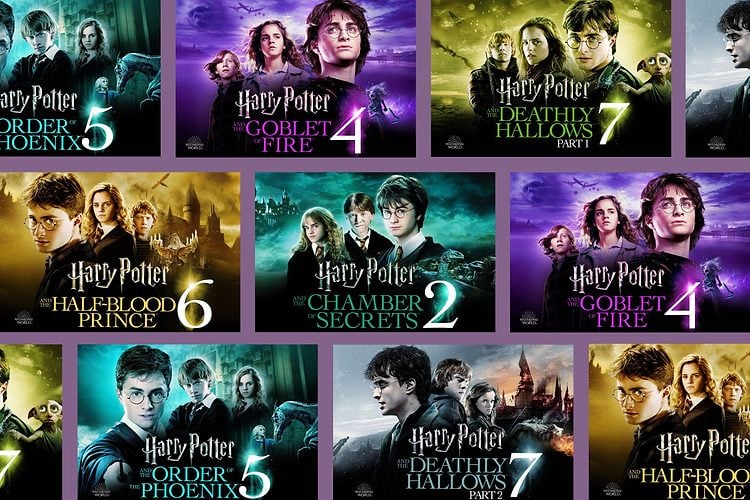
Harry Potter
Few movie franchises have had the cultural impact of Harry Potter. Across eight films, audiences watched Harry, Ron Weasley, and Hermione Granger grow from curious Hogwarts students into young adults caught in a dangerous battle against Lord Voldemort.
The movies transformed J.K. Rowling’s Wizarding World into one of cinema’s most recognizable fantasy universes. From the cozy halls of Hogwarts to the darkness of the final battle, each installment brought something different to the story.
But not every Harry Potter movie is equally memorable.
Some are packed with wonder, humor, unforgettable characters, and spectacular storytelling. Others feel slower, darker, or less balanced than the films surrounding them.
So, if you’re wondering which Harry Potter movie is the best, we’ve ranked all eight films from worst to best.
8. Harry Potter and the Half-Blood Prince
Released: 2009
Director: David Yates
At number eight is Harry Potter and the Half-Blood Prince.
That might seem surprising because the sixth installment contains some of the most important information in the entire Harry Potter story. Harry learns more about Voldemort’s past, discovers the significance of Horcruxes, and begins preparing for the final confrontation.
The problem is that the movie sometimes struggles to balance its different storylines.
The darker elements involving Voldemort and Dumbledore are fascinating, but much of the film also focuses on teenage romance and school relationships. Those moments provide plenty of humor, but they can feel disconnected from the increasingly dangerous world surrounding the characters.
Visually, however, Half-Blood Prince is one of the franchise’s strongest films. The cinematography gives Hogwarts a mysterious, almost gothic atmosphere, while the darker color palette reflects the increasingly grim story.
The film also delivers one of the franchise’s most devastating moments with the death of Albus Dumbledore.
Best feature: Its atmosphere and exploration of Voldemort’s past.
Why it’s ranked eighth: Important story material is occasionally overshadowed by uneven pacing and romantic subplots.
7. Harry Potter and the Chamber of Secrets
Released: 2002
Director: Chris Columbus
The second Harry Potter movie is a charming continuation of the magical world introduced in the first film.
The Chamber of Secrets expands Hogwarts considerably. Viewers are introduced to new creatures, mysteries, characters, and dangers, including Dobby the house-elf, Aragog, the giant spiders, and the terrifying basilisk.
The central mystery is also one of the franchise’s more entertaining ones. Harry must discover who opened the Chamber of Secrets and why students are being mysteriously attacked.
The movie benefits from the sense of wonder established by its predecessor, but its nearly three-hour runtime can make the story feel slower than necessary.
It also lacks some of the emotional maturity that would define the later installments.
Still, the film remains an important part of the franchise because it establishes several elements that become increasingly significant later in the story.
Best feature: The mystery surrounding the Chamber of Secrets.
Why it’s ranked seventh: Fun and atmospheric, but longer and less emotionally sophisticated than the later films.
6. Harry Potter and the Philosopher’s Stone
Released: 2001
Director: Chris Columbus
Everything started here.
Harry Potter and the Philosopher’s Stone introduced audiences to Harry, Ron, Hermione, Hogwarts, Quidditch, Diagon Alley, Hagrid, Dumbledore, and an enormous magical universe that would eventually span eight films.
Its greatest strength is its sense of discovery.
For Harry, the Wizarding World is completely new. And because audiences experience it alongside him, Hogwarts feels genuinely magical.
The film is lighter and more family-friendly than most of its sequels, but that is also part of its charm. The warm cinematography, memorable score, elaborate sets, and Christmas-at-Hogwarts atmosphere give it a timeless quality.
Daniel Radcliffe, Rupert Grint, and Emma Watson were still children when the movie was filmed, and their performances are naturally less polished than in the later films. Yet that youthful energy makes the first movie particularly nostalgic.
It may not have the complexity of the later installments, but without this film, none of the others would exist.
Best feature: The unforgettable introduction to the Wizarding World.
Why it’s ranked sixth: It captures the magic perfectly but lacks the depth and maturity of the later movies.
5. Harry Potter and the Order of the Phoenix
Released: 2007
Director: David Yates
Order of the Phoenix marked a major turning point for the franchise.
Harry is no longer simply attending school and learning magic. Voldemort has returned, the Ministry of Magic refuses to accept the truth, and Hogwarts itself becomes a battleground for political control.
Enter Dolores Umbridge.
One of the most memorable villains in the series, Umbridge is terrifying precisely because she doesn’t behave like a traditional fantasy villain. Her cheerful appearance and seemingly polite manner hide an increasingly authoritarian personality.
The movie also introduces Harry’s secret student group, Dumbledore’s Army, as the young witches and wizards begin teaching themselves defensive magic.
The final battle at the Ministry is another highlight, giving the film one of its most impressive action sequences.
However, the sheer amount of material from the novel makes the adaptation feel compressed in places.
Best feature: Dolores Umbridge and the formation of Dumbledore’s Army.
Why it’s ranked fifth: A darker and more politically charged Harry Potter story with excellent character moments.
4. Harry Potter and the Deathly Hallows – Part 1
Released: 2010
Director: David Yates
The first part of the finale is unlike almost every other Harry Potter movie.
Harry, Ron, and Hermione leave Hogwarts behind and embark on a dangerous mission to find and destroy Voldemort’s Horcruxes.
Without the familiar Hogwarts setting, the movie becomes more intimate and isolated. The trio spends much of the story traveling through forests, abandoned buildings, and remote locations while trying to stay ahead of Voldemort’s followers.
That change in setting gives the film a distinctive atmosphere.
The friendship between Harry, Ron, and Hermione also becomes the emotional center of the story. Their relationship is tested by fear, exhaustion, jealousy, and uncertainty.
Because the film is essentially half of a larger conclusion, its story can feel incomplete. There is no traditional final showdown, and much of the movie is devoted to setting up the events of Part 2.
Nevertheless, its slower pace allows the characters and emotional stakes to breathe.
Best feature: The intimate portrayal of Harry, Ron, and Hermione outside Hogwarts.
Why it’s ranked fourth: A beautifully atmospheric and character-driven chapter, even if it doesn’t feel completely self-contained.
3. Harry Potter and the Goblet of Fire
Released: 2005
Director: Mike Newell
Goblet of Fire is where the Harry Potter franchise truly begins to feel like an epic fantasy adventure.
The Triwizard Tournament introduces Harry to two other magical schools and places him in a dangerous international competition he never volunteered to enter.
The three tournament challenges are among the most entertaining sequences in the series. Harry faces a Hungarian Horntail, explores the depths of the Black Lake, and navigates a massive maze filled with danger.
But the movie’s most important contribution is its transformation of the overall story.
The return of Lord Voldemort changes everything.
The final moments at the graveyard are chilling, particularly because the series suddenly moves from magical school adventure into genuine darkness.
The film also introduces important characters such as Cedric Diggory, Viktor Krum, Fleur Delacour, and Mad-Eye Moody.
Best feature: The Triwizard Tournament and Voldemort’s return.
Why it’s ranked third: Exciting, funny, visually spectacular, and pivotal to the larger story.
2. Harry Potter and the Prisoner of Azkaban
Released: 2004
Director: Alfonso Cuarón
For many fans, Prisoner of Azkaban is the best Harry Potter movie.
It is certainly one of the most distinctive.
Director Alfonso Cuarón brought a new visual identity to the franchise, making Hogwarts feel older, stranger, and more atmospheric. The characters also begin to feel less like children and more like teenagers confronting complicated realities.
The story revolves around Sirius Black, a supposedly dangerous prisoner who has escaped from Azkaban.
But the mystery is far more complicated than Harry initially realizes.
The film introduces some of the franchise’s most memorable characters, including Sirius Black and Remus Lupin, while exploring Harry’s family history in greater depth.
It also contains the unforgettable Time-Turner sequence, which brings together several seemingly unrelated events in a clever and satisfying conclusion.
Unlike some of the other films, Prisoner of Azkaban doesn’t rely heavily on the larger Voldemort storyline. Instead, it focuses on Harry’s personal history, identity, fear, and family.
The result is a movie that feels mature without losing the magic that made the original films so appealing.
Best feature: Its atmosphere, character development, and intricate storytelling.
Why it’s ranked second: A beautifully crafted coming-of-age fantasy that elevated the franchise.
1. Harry Potter and the Deathly Hallows – Part 2
Released: 2011
At number one is Harry Potter and the Deathly Hallows – Part 2.
The final Harry Potter movie has an advantage that none of the others have: it carries the emotional weight of everything that came before it.
For a decade, audiences had watched Harry grow up. They had seen friendships form, characters die, mysteries unfold, and Voldemort slowly return to power.
Now, everything comes together.
The Battle of Hogwarts is the centerpiece of the film, and it delivers some of the franchise’s most spectacular action sequences. But the movie’s greatest strength isn’t the spectacle.
It’s the emotional payoff.
Harry finally confronts Voldemort. Ron and Hermione’s relationship reaches its long-awaited resolution. Neville Longbottom gets one of his most important moments. Several beloved characters make their final stands.
The film also answers questions that had been building since the earliest movies.
The relationship between Harry and Dumbledore receives additional context. The significance of the Elder Wand becomes clear. Snape’s story reaches its heartbreaking conclusion.
And then comes the epilogue, showing Harry, Ron, Hermione, and their families years after the Battle of Hogwarts.
Whether every creative choice works perfectly is debatable, but as the conclusion to one of cinema’s most ambitious fantasy franchises, Deathly Hallows – Part 2 is difficult to beat.
Best feature: The emotional and narrative payoff of the entire franchise.
Why it’s ranked first: It delivers the biggest battle, the most important revelations, and the conclusion fans had spent years waiting for.
The Final Ranking
Here’s our complete ranking from worst to best:
| Rank | Movie | Year |
|---|---|---|
| 1 | Harry Potter and the Deathly Hallows – Part 2 | 2011 |
| 2 | Harry Potter and the Prisoner of Azkaban | 2004 |
| 3 | Harry Potter and the Goblet of Fire | 2005 |
| 4 | Harry Potter and the Deathly Hallows – Part 1 | 2010 |
| 5 | Harry Potter and the Order of the Phoenix | 2007 |
| 6 | Harry Potter and the Philosopher’s Stone | 2001 |
| 7 | Harry Potter and the Chamber of Secrets | 2002 |
| 8 | Harry Potter and the Half-Blood Prince | 2009 |
Which Harry Potter Movie Is Really the Best?
There is no universally correct answer.
If you love the original sense of wonder, Philosopher’s Stone may be your favorite. If you prefer mystery and atmosphere, Prisoner of Azkaban is an obvious choice. Fans who enjoy large-scale adventure might choose Goblet of Fire, while those who want emotional payoff may prefer Deathly Hallows – Part 2.
That’s part of what makes the franchise so enduring.
The eight films don’t all try to do exactly the same thing. The early movies focus heavily on discovery and magical adventure, while the later installments become increasingly serious as Harry’s conflict with Voldemort moves toward its inevitable conclusion.
Taken together, they form a cinematic coming-of-age story that spans an entire decade.
And while fans may never agree on the perfect ranking, one thing is difficult to dispute: the Harry Potter movies remain one of the defining fantasy film franchises of their generation.
